
Onboarding works best when it uses the same product data as the rest of the company.
Analytics teams should not need a separate instrumentation path for flows and checklists. Product teams should not need to rebuild a Mixpanel or Amplitude cohort before they can target it in onboarding. Operations teams should not need custom code for every connection between a completed flow and another business tool.
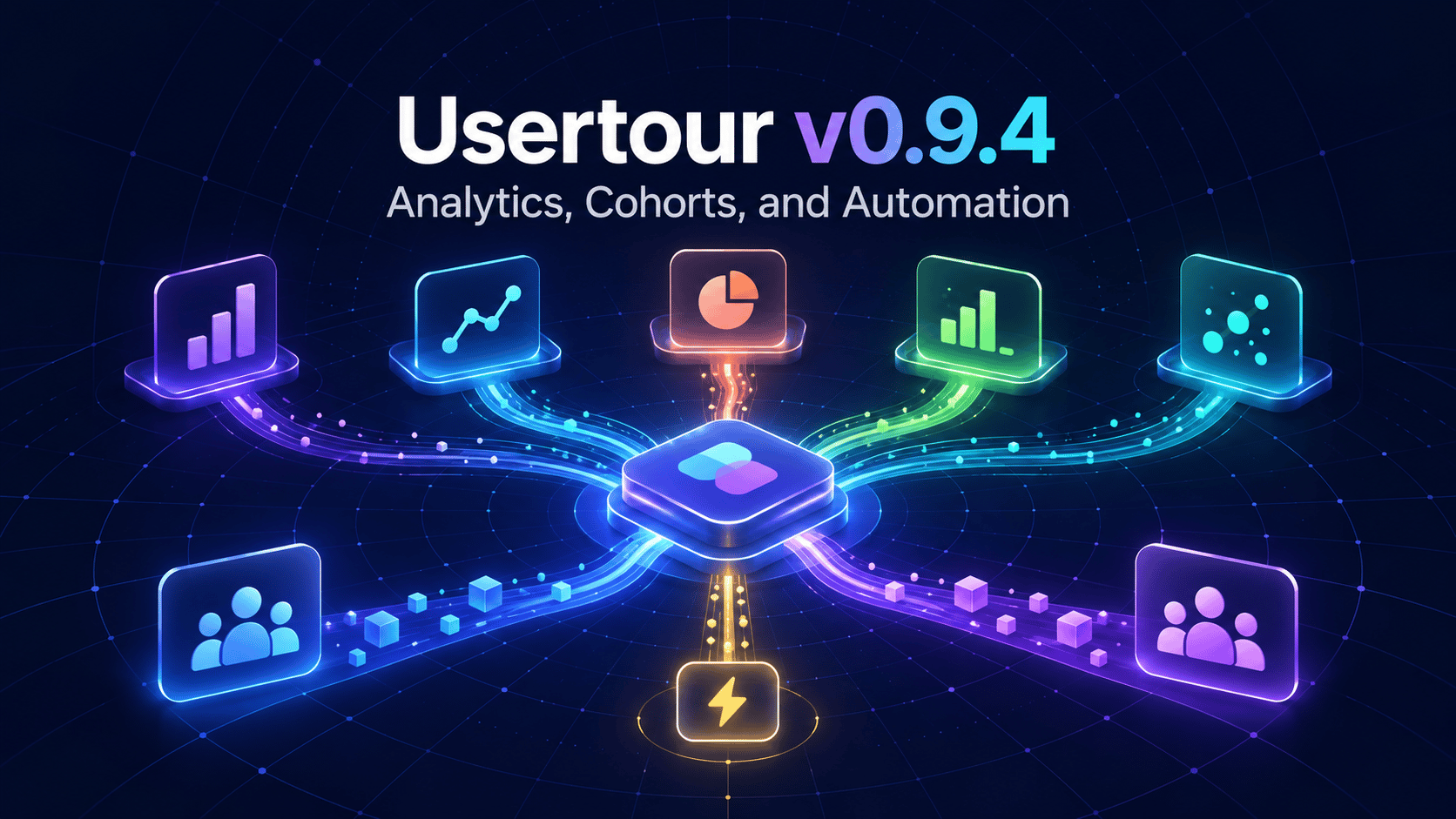
Usertour v0.9.4 connects those systems in both directions.
The release streams tracked events to Amplitude, Heap, Mixpanel, PostHog, and Segment, synchronizes cohorts from Mixpanel and Amplitude into Usertour segments, adds a Zapier app, and lets server-side applications record events through REST API v2.
Stream onboarding and product events to your analytics stack#
The new Settings → Integrations page connects an environment to a supported analytics destination. Add the provider credentials, choose a region where supported, and turn on Event streaming.
From then on, the destination receives the environment's complete tracked-event stream:
- Flow and checklist lifecycle events
- Survey answers
- Launcher activations
- Custom product events
page_viewed
The integration sends events using the time the event occurred, not the time delivery succeeded. Mixpanel and Amplitude also receive the outbound message ID as their deduplication key, so a retried delivery does not inflate the count.
Each lifecycle event carries a session identifier under a type-specific property such as flow_session_id or checklist_session_id. Analytics queries can reconstruct one user's journey instead of seeing an unrelated list of events.
The same delivery guarantees as webhooks#
Analytics integrations use the outbound ledger introduced for webhooks in v0.9.3. That gives every provider connection:
- Eight delivery attempts over roughly 24 hours
Retry-Aftersupport- Cooldown when a destination repeatedly fails
- Automatic disable and owner notification after seven days of continuous failure
- A 30-day message log with payloads and attempts
- A Send test event action
Updating a credential or region affects deliveries already waiting to retry. Provider keys are encrypted at rest and never returned by the API; the dashboard displays only the last four characters for identification.
Analytics integrations are available from the Starter plan on Usertour Cloud and are not gated on self-hosted instances.
Bring Mixpanel and Amplitude cohorts back into Usertour#
Event streaming sends onboarding data out. Cohort sync brings product intelligence back.
Enable Cohort sync on a Mixpanel or Amplitude connection and Usertour provides a receive URL. Configure it as a cohort-webhook destination in the analytics platform, then choose the cohorts to synchronize.
Each cohort becomes a read-only Usertour segment with the provider's identity visible in the segment list, user list, and condition builder. It can target flows, checklists, announcements, and other content like a native segment.
That enables audiences such as:
- Power users who have never tried a newly launched workflow
- Accounts that reached a usage threshold but did not invite teammates
- Dormant users selected by a behavioral model in the analytics platform
- Customers who adopted one feature but not the complementary feature
Membership follows the provider's enter and exit batches. Full-roster exports replace the provider-owned membership so users who leave the cohort also leave the segment. A cohort synchronized from several environments converges on one project-level segment, keeping targeting consistent.
If a cohort includes an ID Usertour has not seen, Usertour creates a bare user with only that external ID. The user can be targeted on their next visit without copying analytics properties into Usertour attributes.
Deleting an integration releases its synchronized segments as normal editable segments rather than deleting them, so live targeting never breaks unexpectedly.
Connect Usertour to thousands of apps with Zapier#
Usertour is now available on Zapier.
Triggers include:
- Flow Started, Completed, and Ended
- Checklist Completed
- Survey Question Answered
- Launcher Activated
- User Created
- Event Tracked, with custom events available in the picker
Actions create or update users and companies and track events. Find User and Find Company support Zapier's standard find-or-create workflows.
Zapier triggers create ordinary environment webhooks labeled Managed by Zapier, so they receive the same retry, cooldown, and message-log behavior as a manually configured endpoint. Those managed webhooks should remain under Zapier's control; deleting one directly stops the corresponding Zap.
The Zapier integration guide covers authentication and the available triggers and actions.
Track product events from server-side code#
Some important product events happen outside the browser: a payment succeeds, an import finishes, a background workflow completes, or a plan changes.
The new REST API v2 event endpoint records those events for a user through the same pipeline as SDK events. Webhooks, analytics destinations, Zapier, and Usertour targeting all see the result consistently.
The endpoint can:
- Create a bare user when the external ID is new
- Register an unknown custom event on first use
- Add new attribute names to the event definition
- Backdate the event using
occurredAt
Built-in Usertour event names are reserved and refused. That prevents an application from forging lifecycle analytics such as flow_completed.
GET /v2/me also gives integration platforms a way to validate a pasted bearer token and discover the projects and environments it can access.
Localize where links lead#
v0.9.4 extends localization beyond link labels. Inline rich-text links and image click-through links now expose their destination as a localization unit.
A French translation can therefore link to French documentation while the source language points to the English page. Destinations move through CSV export and import, are excluded from machine translation, and do not count as missing translatable copy.
One event pipeline, many destinations#
The larger change in v0.9.4 is architectural as well as visible: SDK events, server-side events, webhooks, analytics providers, cohort sync, and Zapier now share explicit contracts instead of behaving like disconnected features.
That makes onboarding easier to measure in the analytics tools a team already trusts—and makes those analytics audiences immediately useful inside the product.
Read the full v0.9.4 release notes. Previous: v0.9.3: Outbound Webhooks. Next: v0.9.5: HubSpot Sync and Safer Team Publishing.